

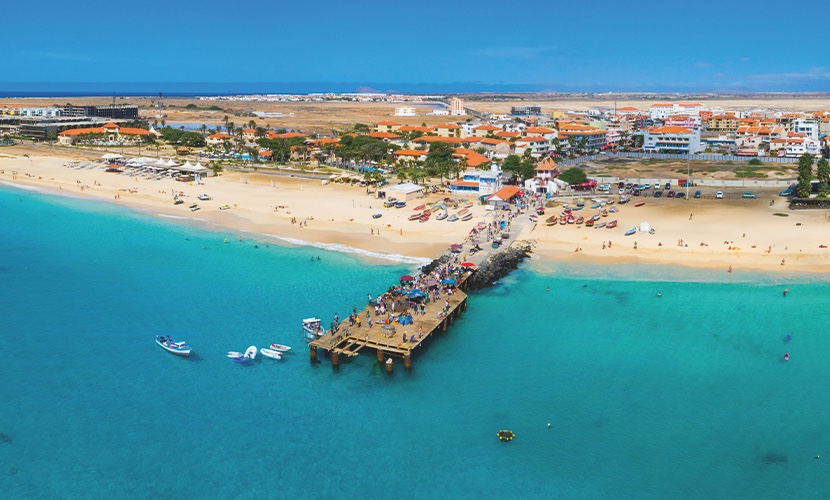
Sal Leads Cape Verde’s Tourism Growth as Hotel Guest Numbers Rise 16.5%
The island of Sal has reinforced its position at the heart of Cape Verde’s booming tourism industry as new official figures reveal that the country welcomed almost 1.18 million hotel guests during 2024.
Data released by Cape Verde’s National Statistics Institute (INE) shows that hotels and other tourist accommodation across the archipelago welcomed 1,177,467 guests during 2024 – an increase of 16.5% compared with 2023.
Sal remained comfortably the country’s leading tourism destination, accounting for 58.5% of all guest arrivals in hotel establishments.
The figures provide another indication of the continued expansion of Cape Verde’s international tourism industry and the growing importance of Sal as its principal resort island.
For The Resort Group Plc, which has played a major role in the development of Sal’s international resort offering, the figures underline the long-term potential identified on the island.
The Group’s developments include The Lagoon Resorts, its collection of Meliá hotels on Sal, which has helped create the scale and quality of accommodation required to serve the island’s expanding international visitor market.
Rob Jarrett, Honorary Chairman of The Resort Group Plc, said:
“These figures demonstrate the extraordinary progress Cape Verde has made as an international tourism destination and, particularly, the strength of Sal.
“For one island to account for almost six out of every ten hotel guest arrivals across the entire country is significant. Sal has established itself as the engine room of Cape Verde’s tourism economy.
“We recognised the island’s potential many years ago and have remained committed to its long-term development. The combination of year-round sunshine, outstanding beaches, a relatively short flight time from Europe and the warmth of the Cape Verdean people gives Sal an exceptionally strong proposition in the international holiday market.”
The growth extends beyond visitor numbers. Cape Verde recorded 5,651,774 overnight stays during 2024, representing an increase of 9.7% compared with 2023.
Growth was recorded across every quarter of the year, with the fourth quarter producing the strongest performance. Between October and December alone, accommodation establishments welcomed 389,018 guests and recorded 1,556,427 overnight stays.
Hotels continue to dominate Cape Verde’s accommodation market, accounting for 81.8% of guest arrivals and 84.4% of overnight stays during the year. Hotel-apartments represented a further 12.7% of arrivals.
That concentration of demand in established hotel accommodation is particularly significant for Sal and for resort destinations such as The Lagoon Resorts.
Lisa Kellett, Chief of Staff for The Resort Group Plc, said:
“The scale of the growth is extremely encouraging, but what is particularly important for us is the continuing strength of the hotel sector and Sal’s position within the national tourism market.
“International visitors increasingly want destinations that combine dependable weather and beautiful surroundings with high-quality accommodation, restaurants, leisure facilities and a complete resort experience. Sal is increasingly able to deliver all of those things.
“The Lagoon Resorts and our Meliá hotels form part of that wider tourism ecosystem. As visitor numbers grow, it creates opportunities not simply for resorts and hotels but for local employment, suppliers, restaurants, excursions and businesses throughout the island.”
British holidaymakers remain crucial to Cape Verde
The statistics also underline the importance of the British market to Cape Verde.
International visitors overwhelmingly dominate the country’s tourism industry, with non-residents accounting for 94.9% of guest arrivals and 97.5% of overnight stays in 2024.
The United Kingdom remained Cape Verde’s largest international source market, generating 29.9% of non-resident guest arrivals.
Its importance becomes even clearer when overnight stays are considered. British visitors generated 35.1% of all overnight stays by non-residents, ahead of Germany, Belgium and the Netherlands, Portugal, France, Sweden and Italy.
The figures come as connectivity between Britain and Sal continues to develop. On 31 March, just one week before the latest tourism statistics were released, easyJet launched its first-ever sub-Saharan African route, connecting London Gatwick directly with Sal three times a week throughout the year.
The combination of increased airline capacity and sustained demand from British holidaymakers offers another potential catalyst for Sal’s tourism economy.
Sal remains Cape Verde’s tourism powerhouse
Sal’s 58.5% share of hotel guest arrivals placed it significantly ahead of Cape Verde’s other islands.
Boa Vista accounted for 24.1% of arrivals, followed by Santiago at 8.0% and São Vicente at 4.4%. All the remaining islands combined accounted for just 4.9%.
Cape Verde’s overall average hotel stay stood at 4.6 nights in 2024, while the average bed occupancy rate increased to 60%.
For The Resort Group Plc, the latest statistics strengthen the case for continued confidence in Sal and its tourism infrastructure.
Rob Jarrett added:
“Tourism growth on this scale creates a responsibility to think long term. The objective cannot simply be to attract greater numbers of visitors; it must be to ensure that growth creates sustainable economic opportunities and continually improves the quality of the destination.
“Sal is now competing on an international stage. Continued investment in accommodation, infrastructure, connectivity, service and the wider visitor experience will be essential to maintaining that momentum.”
With Cape Verde’s hotel guest numbers rising by 16.5% in a single year, international visitors accounting for the overwhelming majority of demand and Sal attracting more than half of all arrivals, the latest statistics point towards an increasingly mature tourism market.
For Sal, they also reinforce something The Resort Group Plc has long believed: the island is no longer simply an emerging destination.
It has become Cape Verde’s tourism powerhouse.